
Copyright
The First Threshold
A CosmOS Novella
Copyright © 2026 Matthew L. Fraser. All rights reserved.
This is a work of fiction. The characters and events of this story belong to its imagined universe.
Working manuscript · September 2026
Publication details and ISBN: not yet assigned.
Dedication
For those who care, fix what breaks, and build what they believe in.
I hope you find a little of yourself in these pages.
Author’s Note
Every story begins with a threshold.
It is tempting to look past it, toward whatever waits on the other side. Instead, I wanted to linger here for a moment, in the mundane: a job interview, a building full of ordinary problems, and people trying to make their way through an ordinary day.
The First Threshold opens in the years before The CosmOS, when the extraordinary has yet to become familiar. Wonder arrives among people, each with their own hopes, responsibilities, choices, and consequences.
What we discover, and what we choose to do, matter.
Thank you for stepping through. I hope you find wonder here.
Matthew L. Fraser

Arrival
I’d watched the same black suitcase circle three times before checking the arrivals board and discovering that I’d been waiting for the wrong flight.
My suitcase was not on that carousel.
A good start…
I stepped aside for a family with two sleeping children and found the correct carousel across baggage claim. My suitcase was there, travelling alone with an orange priority tag that belonged to somebody else.
I grabbed its handle, pulled it off the belt, thanked the airport employee who’d pointed me in the right direction, and followed the signs toward the taxi bay.
As I got to the doors, I took out my travel folder.
Inside were my flight itinerary, a printed map to the hotel, the address of Aegis headquarters, and two taxi numbers I’d written down in case my phone died.
Tucked behind them was the job listing.
Executive Assistant, Founder Office. Full-time, High-trust executive operations.
I’d read it often enough to know it by heart. I still couldn’t say exactly what the job involved.
I’d done this kind of work before. A company didn’t usually fly you across the country for an interview unless it was reasonably confident you could do the job.
What I couldn’t work out was which job, exactly, Aegis thought I was interviewing for.
The recruiter had asked me to arrive no more than fifteen minutes before the interview. I checked the hotel address against the map, put the folder away, and joined the taxi queue.
A little boy ahead of me sat on a hard-shell suitcase and spun himself in circles until his mother caught the handle. He waited for her to look at her phone before starting again.
My driver arrived a few minutes later.
“Where to?”
I gave him the address. He loaded my suitcase, asked whether I was travelling for business, and wished me luck when I mentioned tomorrow’s interview.
We joined the traffic toward the city. Overpasses, underpasses, bridges, smaller roads — San Francisco didn’t seem interested in introducing itself one street at a time.
I opened my notes.
The recruiter had been thorough about what they expected from me: confidentiality, competing demands, people management, and something called being Aegis strong. She’d been considerably less forthcoming about what I could expect from them.
I considered adding another question, then closed the document.
Eleven questions was probably enough.
Outside, the city appeared in pieces. Low buildings gave way to taller ones. Office windows shone above busy streets. A delivery truck had stopped with its hazard lights flashing, and a cyclist was trying to work out how to get around it.
The driver muttered at the traffic and changed lanes.
Between two buildings, I caught my first real glimpse of the bay.
I’d seen photographs, of course. Who hadn’t?
This might sound weird, but what I hadn’t expected was the water to appear so suddenly in the middle of everything.
I put my phone away and watched out the window until we turned another corner. There would be time for notes tomorrow.
The hotel room had a wall of glass where a normal in-wall window would have been. The room sat overlooking a small corner of the business district harbour.
It had a bed large enough for three people, a chair I suspected nobody had ever sat in comfortably, and a desk.
I was sitting on the edge of the bed with one shoe off, my suitcase beside the door. The Bay Bridge lit up across the dark beyond the window. Far below, people were still walking dogs, and biking along the waterfront.
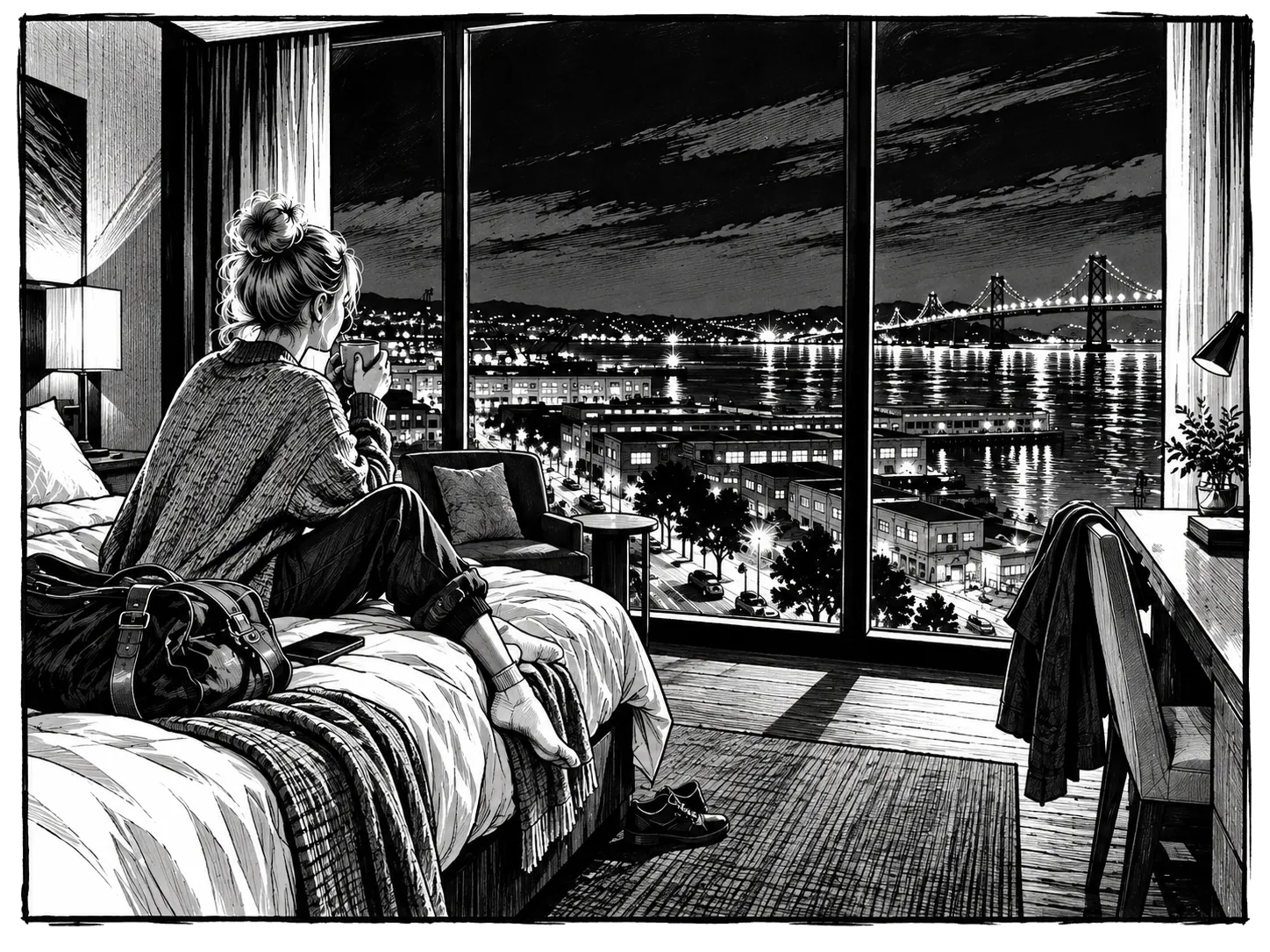
I’d promised Mom I’d call when I got settled. She’d insisted on staying up despite the three-hour difference and my assurance that I was perfectly capable of finding a hotel on my own.
She answered on the second ring.
“Did you land?” she asked, with the urgency she reserved for my travel plans.
“No, Mamma. This is an elaborate voicemail from the Atlantic.”
“Natalie.”
“I’m at the hotel, Mamma. It’s gorgeous, I can see the bay from my bed.”
“Lovely. Now, have you eaten?” she continued, concluding her check up on me.
I told her about the airport muffin I had that morning.
“That was this morning, älskling. Find the room service menu for me.”
I found the room service menu. She stayed on the line while I ordered some dinner.
“Good. Now tell me about the trip.”
I admitted to waiting at the wrong baggage carousel. She laughed, then established that I’d recovered everything. Once she was satisfied with my luggage story, she wanted to know whether the company had treated me well.
“They’ve organised everything,” I said. “It’s almost embarrassing.”
“That’s their business. You’re there for an interview, Sweetie.”
“An interview for a job nobody’s fully explained.”
“Well, you’ll meet them tomorrow, and you have your questions.”
I pulled off my second shoe and set it beside the first. I’d already asked the recruiter what the work involved and been told we’d discuss it in person. There wasn’t much more to learn tonight. I was just whining.
“I hope I like it here.”
“So do I, älskling.”
Dad called something from the kitchen, then I heard him coming closer.
“Did you pack your navy sweater?”
“The grey one.”
“Ah. Well, that’s a sweater too, I suppose.”
“It’ll do the job, Dad.”
“Good. Love you, sweetheart.”
“Love you too.”
I could picture them in their kitchen: Dad with his tablet, Mom in the cardigan she wore whenever the apartment got cold. She’d have made tea even though it was late. He’d complain about the hour and drink it anyway.
For a moment, I wanted to be there with them.
Mom reclaimed the phone.
“He worries about these things.”
“Now eat your dinner and get some sleep. Call me tomorrow, yes? I want to hear what they’re like.”
“I will. Love you, Mamma.”
“Love you, älskling.”
The call ended.
I sat for a moment, listening to the air conditioner. Then I laid out the gray sweater and ran the shower hot, hoping the steam would do what my travel brush probably couldn’t for my hair.
Dinner arrived while the bathroom window partition was still fogged.
I ate the sandwich at the desk and opened my notes again. The questions looked fine. I’d probably prepared too many, so I put a star beside the three I actually wanted answered.
What would I be responsible for?
What decisions would I make?
Who would I report to?
Then I fell down a rabbit hole looking up Aegis.
Nearly eight hundred thousand employees, with offices on six continents. Immersive gaming systems, medical research, industrial networking technology, and a philanthropic arm large enough to hold its own annual summit.
There was plenty written about the company and very little that agreed, as is often the case with tech giants, I supposed.
Depending on which article I believed, Aegis was developing a medical simulator, a military training environment, or the world’s most expensive privacy lawsuit.
The founder was easier to find but harder to understand.
Most articles began with billionaire. After that, the descriptions varied.
Inventor. Recluse. Futurist.
He avoided interviews so thoroughly that several profiles were mostly about his refusal to give one. Though I did find a few videos of him speaking on stage. He had a thick Scottish accent, a slender build, and a stern face.
I meant to put my phone down.
Instead, I woke at 3:12 a.m. with the bedside lamp still on, the room service tray beside me, and my phone screen on.
“Absolutely not,” I told the article.
I closed it, turned off the lamp, and went back to sleep.
By morning, the bay had turned silver-blue beneath a warm sky.
I considered that a good start.
The coffee shop around the corner had six people in line and a pastry case that looked considerably more competent than the one at the airport. I ordered a latte and a croissant, collected them, and headed outside.
I walked the last six blocks to Aegis because I had time to explore.
Delivery trucks were unloading. Cyclists passed in little groups. People with badges clipped to their bags hurried toward offices.
Outside one building, a man watered the planters with the concentration of someone determined to finish before the morning rush.
I liked watching the city begin its day.
I finished my croissant, folded the paper bag, and put it in a bin.
Then I checked the address.
Twice.
The building didn’t announce itself.
No enormous logo. No founder sculpture that required its own security perimeter. No bright lobby display promising to reinvent the future.
Just glass set back from the street, benches that were probably security bollards, and small brushed letters beside the entrance.
AEGIS.
I went inside.
The lobby was all pale stone, soft light, and carefully maintained plants. A moss wall stretched behind the seating area.
The woman behind reception watched me steadily from the moment I opened the door. She had dark skin, tightly restrained black locs and an expression that suggested she had little patience for anyone wasting her time. Her badge read IMANI CALDER — SECURITY MANAGER.
“Identification,” she said, holding out her hand.
Ms. Calder checked it, directed me in front of her webcam, gave me a visitor confidentiality form to sign, and provided a badge with my face and name on it from under her counter.
“Someone will collect you shortly. You’re welcome to sit anywhere in the waiting area.”
She gestured toward the chairs and turned back to her monitor.
My badge read Candidate. Black text, white card, thin amber stripe.
I put the lanyard over my head and sat down.
At 8:57, a serious woman in a charcoal jacket stepped out from behind the security gates.
“Miss Vale?”
I stood, nearly forgetting the coffee balanced on my knee.
“Mara Chen.” She offered her hand. “How was your journey?”
“Good. Found my luggage eventually - after a brief disagreement with the baggage carousel.”
She half-smiled, half-grimaced and led me through the gates.
We took the lift up to the 4th floor, Mara tapping her ID card as we passed through each secured door.
Everything looked reassuringly ordinary. Glass meeting rooms, whiteboards, people carrying laptops and lunch containers. Someone had opened a printer and was staring into it with the weary concentration of a person who’d been there before.
A man hurried past Mara with a tablet. “Room eight’s double-booked.”
“Facilities know. Use six.” He thanked her and kept moving.
I relaxed a little.
Mara took me to a conference room overlooking the city. There was a table, a carafe of water, two chairs, and a display showing the Aegis logo.
“I’ll be conducting the first part of your interview,” she said as we sat. “The founder is listening remotely and may join us later. Is that all right?”
She pointed to her earpiece.
I glanced at the small earpiece tucked beneath her hair.
“Of course!”
“Good. We have about forty-five minutes scheduled. I’ll leave time for your questions.”
She opened my application. “Let’s start with your previous role.”
For the next fifteen minutes, we went back over some of the questions I’d answered by phone before the flight over. I could have been interviewing at almost any large company.
Mara wanted to know which teams I’d supported, what software I’d used, and how I handled competing priorities. She asked about travel arrangements and expense approvals, then returned to something I’d mentioned about a manager whose appointments regularly overran.
“How did you handle people waiting outside his office?”
“Mostly by asking what they’d come for. Half the time, they didn’t need him at all — they needed someone in another department.”
I told her about a team that kept arriving without appointments because Finance was denying their travel requests. They thought the system was broken, but had been charging everything to a project code that had closed a few weeks earlier.
I found the replacement code, updated the requests, and showed them who to contact next time.
She smiled and noted something on my application.
We covered a few more scheduling problems and departmental tangles. I’d met enough people who thought an executive’s office could fix everything. Mara didn’t need convincing; she wanted to know what I’d actually done about them.
Mara was difficult to read. She didn’t nod encouragingly while I spoke, or offer the little reassurances interviewers usually gave when they wanted you to keep talking.
I caught myself adding details to an answer she’d already accepted.
She waited until I finished, made a note, and moved on.
I was beginning to understand why she’d been chosen to interview me.
She was halfway through a question about handling unfamiliar work when she touched her earpiece.
Her expression didn’t change, but she listened for a moment before closing my application.
“Let’s move on to the exercise.” She opened the folder between us.
“These are adapted examples of requests received by our executive offices. The identifying details have been removed, and none contains confidential information.”
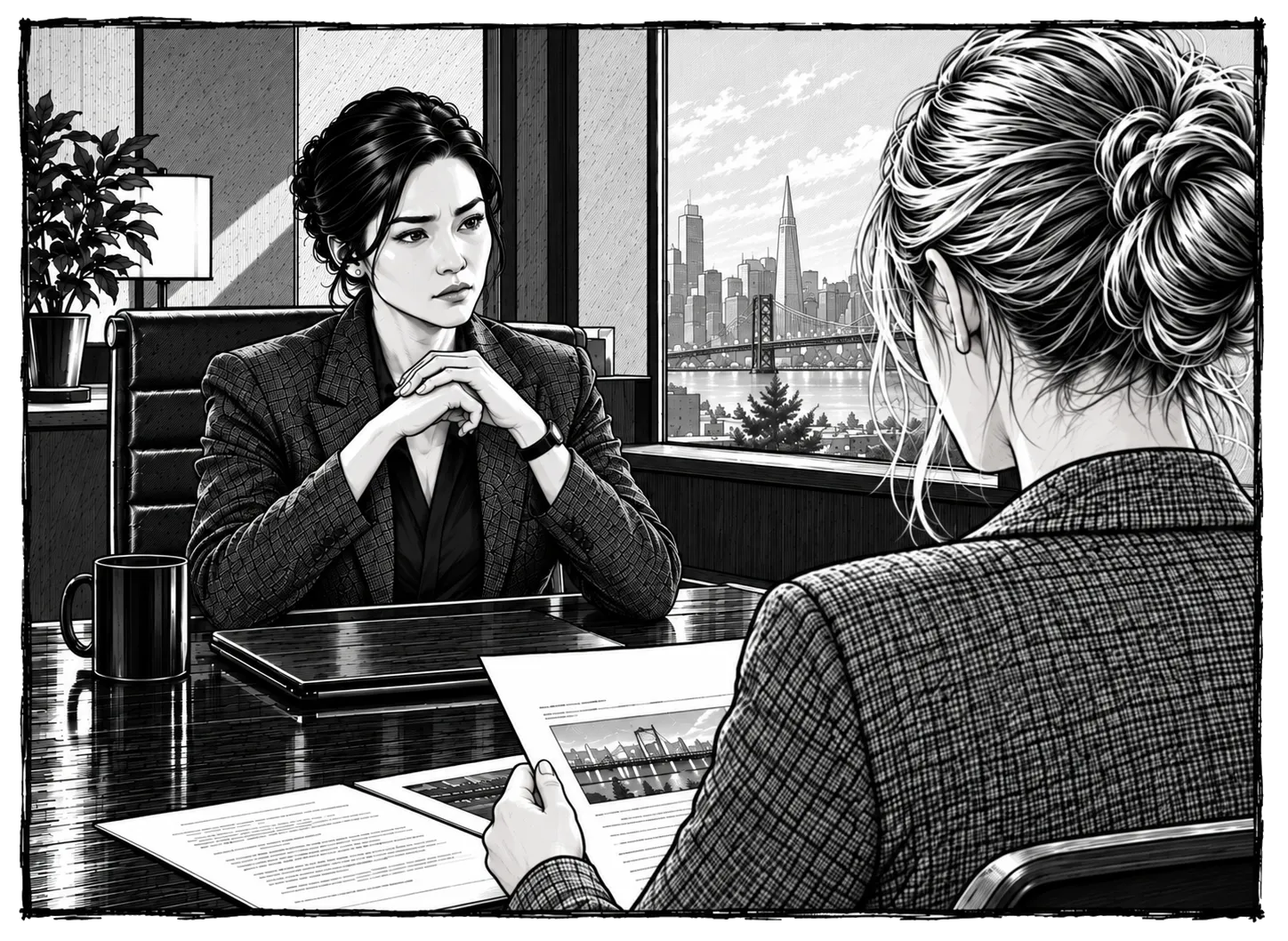
The first was a poorly written documentary proposal sent from a college address. The second was a backhand marketing attempt from a newly formed communications firm offering branding and stabilization services.
“That seems quite rude,” I said.
The documentary could probably go to Public Communications. The other letter belonged in the bin, though I was curious what the firm thought needed stabilizing.
Mara asked what I’d say to either sender.
“Not much. I think I’d pass the documentary along, but I wouldn’t promise anyone an interview. And I’m certainly not signing Aegis up for branding services.”
She made a note and passed me the third request.
It was longer.
An external organization had written about a proposed technology demonstration. It wanted to know who could stop the procedure if a participant became unwell, what medical assistance would be available, and whether independent observers could attend.
The final page requested access to the underlying research as a show of good faith.
I read it twice.
“Hang on, there are two different things here. Someone wants to know whether people will be safe, and then they want the research itself. I’d keep those apart.”
“How would you handle the correspondence?”
“I’d check which department owns the safety questions and whether they’ve already been answered. I’d keep the research request separate and send it through the proper approval process. I wouldn’t promise either one anything.”
Mara touched her earpiece. After listening for a few seconds, she looked back at me.
“Suppose Aegis hasn’t announced a program or product demonstration.”
I looked down at the letter again.
Proposed demonstration.
“Oh.”
It was right there. I’d read the thing twice.
“Well, that’s embarrassing.”
Mara said nothing. Somehow that was worse.
“All right. First, I wouldn’t confirm that the demonstration exists. I’d check the previous correspondence and consult Legal about what we can say. But I’d still make sure the safety questions reached whoever was responsible for assessing them.”
“And if they keep asking?” Mara said. “Would you reject the whole letter?”
“I’d refuse the research access unless someone authorised it. But I wouldn’t throw out a genuine safety concern just because it came in the same envelope. I’d check whether the questions had already been answered and whether they’d raised anything new.”
Mara leaned back and tapped the letter. “We get a lot of requests that belong with other departments. Passing every difficult one straight to Legal doesn’t always help. Sometimes it just gives them more work.”
“Then I’d need to know what’s already been decided, and who can reopen it if something genuinely new comes up.”
Mara wasn’t finished with me.
We went through meeting requests, access requests, and people who apparently thought a refusal was just the beginning of a negotiation.
Half the job seemed to involve knowing who should make a decision, and the other half involved convincing people that the decision had already been made.
I asked how often those boundaries caused problems.
“Often enough that we’re always hiring.” She glanced at her watch, then touched her earpiece.
This time, she smiled - it was almost scary.
“One moment, please.” She crossed to the door.
I sat back and looked at my notes. This work was interesting enough to forget somebody else was listening.
My coffee had gone cold.
There was a quiet exchange outside. I caught a Scottish accent and a few words I couldn’t make out.
Then Mara opened the door.
The man who entered carried a tablet and a mug.
I recognized him immediately, though he looked considerably more tired than the photographs suggested. His clothes were neat, but his hair seemed to have reached an arrangement without consulting him.
I’d spent half the previous night reading about this man. Now he was standing in front of me holding what looked like the same sort of coffee mug Dad kept beside the kitchen sink.
For some reason, that made him much less intimidating.
“Natalie. Thank you for coming.”
I remembered I was supposed to stand up.
I stood and shook his hand.
“Thank you for the opportunity, sir.”
Mara gathered her notes. “I’ll be available afterward if you have questions about the role or the recruitment process.”
“Thank you.”
She gave me a nod and stepped outside.
The founder took her chair.
“Mara says you changed your answer halfway through the exercise,” he said.
“She pointed out what I’d missed.”
“You could have defended your first answer,” he said slyly.
He set his mug beside the folder. “I was the one who refused that request.”
“Oh.” That surprised me. I glanced at the letter, still open between us.
“You sound disappointed.”
“No, sir. Just wondering whether I should reconsider everything I’ve said for the last twenty minutes.”
He smiled. “Should you?”
“Not without knowing why you refused it.”
He considered that for a moment.
“The safety concern had already been assessed,” he said. “The sender had approached several departments and changed the wording each time. Nothing confidential left the company, and I intend to keep it that way.”
I hadn’t known that when I’d read the letter. I looked at the safety questions again.
“Then I’d check the record before drafting anything. If there’s genuinely new information about a participant’s safety, the responsible team still needs to see it. Otherwise, I’d use the response that’s already been approved. The research request stays refused.”
His expression tightened. “Even if I thought the matter was finished?” he asked, raising an eyebrow.
“If there were a new safety concern, yes, sir. I’d raise it through the proper process. I wouldn’t reopen a settled case just because someone keeps asking.”
He looked at the exercise folder for a moment, then closed it.
“Good. Mara knows our procedures better than I do. What I need is someone who’ll use them, even when I’m the one making things difficult.”
“Does that happen often?”
“Mara could give you a more accurate figure,” he said with a smirk, glancing toward the door.
I smiled nervously. That was the first time since entering the building that I could imagine speaking to him across an actual desk instead of an interview table.
He began describing the position.
The Founder’s Office already had a team, with Mara overseeing the day-to-day work while the assistant position was vacant, and established relationships with Legal, Security, and Operations.
It didn’t need someone to invent those arrangements. It needed another person to manage the growing volume of requests reaching the founder after other departments had already made decisions.
“Why do they keep coming to you?” I asked.
“Because I occasionally give them a different answer…”
He said it with enough resignation that I suspected someone had raised the point before.
“That’s going to make things tricky.”
“Yes,” he said, lowering his gaze to the side. “I’d prefer to stay out of the limelight, but every time I make an exception, I give people another reason to come straight to me.”
We talked about what I could refuse, what I’d be expected to escalate, and who would support me when someone objected.
He was clear that I’d be managing access to his office, not ownership of the company. I appreciated that distinction!
“What if I think you’ve missed something important?” I asked.
“You’d have access to my schedule. If I’ve overlooked something, I expect you to tell me.”
“And if you disagree that it’s important?”
“Then we find out who has the authority to decide. If it’s a qualifying concern and I’m blocking it, there’s a board committee responsible for oversight.”
“Could I raise it with them?”
“Yes, through the same process as anyone else. You wouldn’t need my permission.”
He didn’t offer to make me an exception. I preferred that.
He turned his tablet toward me.
A calendar filled the screen, its confidential meeting details hidden behind coloured blocks. Several appointments overlapped, and tentative holds occupied most of the available gaps.
“That’s my actual schedule. Where would you start?”
“I’d start by clarifying which are actual appointments, which are calls, and which are people hoping for one?”
He tapped one of the overlapping blocks. “That’s what she keeps telling me.” He gestured towards the door at Mara.
I smiled. “Have you listened?”
“Occasionally.” He winked slyly.
He showed me how department heads could request time and admitted that he sometimes added appointments himself without telling the office.
We spent a few minutes sorting what his office could resolve and what genuinely required his attention. When I noticed a lunch break buried beneath two tentative meetings, I pointed it out.
“Do either of those have a clear agenda?” He checked.
Neither did.
“I’d get your office to follow up. No sense guessing why we’re needed.”
The appointments stayed where they were. Someone would have to contact the attendees, find another time, and update the schedule.
“Do you feel strongly about lunch?” he asked.
“My mother does.”
“She sounds a smart woman.”
He closed the calendar, and flipped over the tablet. “Why do you want this job?”
I’d prepared an answer about seeking a challenging role at a company doing important work. It was true, in the vague way interview answers could be true.
I considered using it.
Instead, I told him I liked the way Mara had conducted the interview. She knew the work, corrected me when I suggested something impractical, and didn’t expect me to understand a company I’d never worked for.
“I’ve worked for people who wanted everything fixed but wouldn’t let me make the smallest decision,” I said. “I don’t want another job like that. I like that Mara told me when I was wrong.”
He considered that. “Some of the work here will be unpleasant.”
“I thought it might be. I haven’t said yes yet.”
He gave a short laugh.
We discussed the information I’d need to manage requests responsibly. He couldn’t promise me access to everything, and I didn’t ask for it. But he agreed that I would need to know which decisions had already been made and who was authorised to change them.
I made another note.
There was plenty I still needed to ask Mara.
For the first time since I’d applied, though, I could picture an ordinary day in the role.
The thought was considerably more persuasive than the company’s corporate website.
I closed my notebook.
There was one thing I’d been wondering since the lobby.
“Why call it Aegis?”
He looked toward the window.
“It was a project name originally, one of our early ones.”
“Was it a shield?”
He smiled a little. “Something like that.”
I waited to see whether he’d say more.
He didn’t.
I glanced at the clock. We’d gone well past the forty-five minutes Mara had scheduled.
Mara returned and glanced at the exercise folder.
“You’re going to be late for your eleven o’clock, sir.”
He looked at the tablet, less comfortable than a moment ago.
“Thank you for coming, Natalie. I hope to see you again.”
He smiled and left.
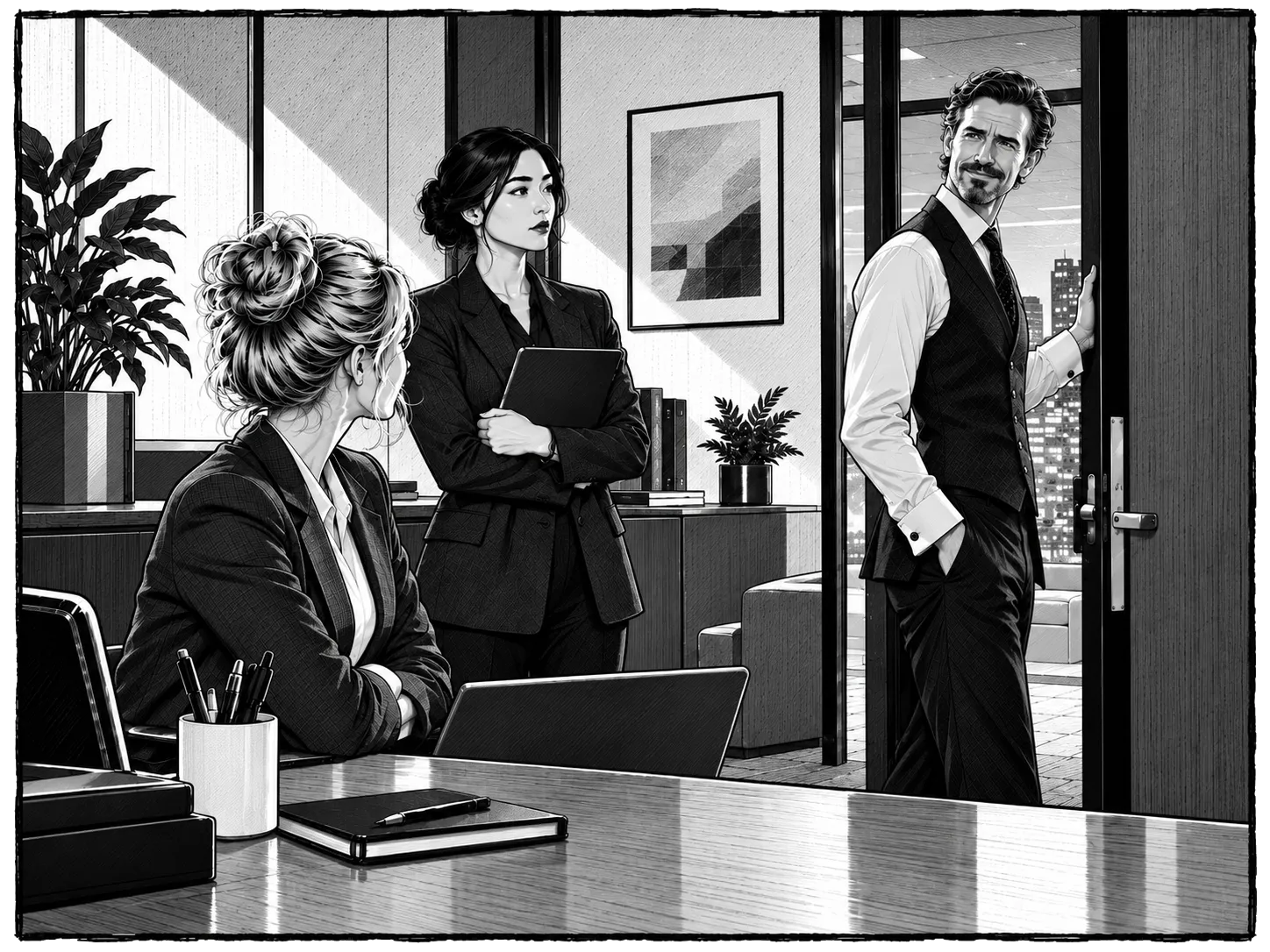
Mara waited until the door closed before sitting opposite me.
“Well. How are you feeling?”
“I’d like to ask about the hours.”
“That’s a good place to start.” She opened her notebook.
We talked about working arrangements, travel, salary, benefits, and the size of the office team. She didn’t promise a standard nine-to-five schedule. She did explain how coverage worked and what the company expected when the founder travelled.
It sounded demanding, but the hours were more flexible than I’d expected.
As long as the founder was where he needed to be and people could reach him when they were supposed to, Mara didn’t seem particularly concerned with how I arranged my day.
When we finished, Mara walked me back toward the elevators. “We’ll be in touch later today, after the other interviews.”
“Thank you.”
She left me in a small waiting area while she went to collect my visitor paperwork.
I opened my notebook and found the three questions I’d starred the night before.
I read them again, mentally filling in the answers.
What would I be responsible for?
Managing his access and schedule, and keeping requests in the right hands. That was considerably more interesting than the job listing had made it sound.
What decisions would I make?
Scheduling and correspondence — more than I’d expected, but within the office’s remit.
Who would I report to?
I’d managed to discuss salary and travel without asking who I’d actually report to. Mara? The founder?
Two out of three wasn’t bad. I could ask about the third when they called.
I closed the notebook and took out my phone.
Mom had texted three times.
How did it go, sweetie?
Are you alive?
Your father says ask about dental.
I stared at the messages until I smiled.
I could picture them discussing it in their kitchen. If Aegis offered me the job, I’d be a long way from that kitchen for more than a few days.
Then I typed:
Still alive. Dental pending. I really like this place.
I read it once and sent it.
They hadn’t offered me anything yet. I still had questions, and I suspected the founder’s calendar could keep me occupied for years.
But for the first time since booking the flight, I knew I wanted them to call.
The Call
After the interview, I walked back to the hotel with my notebook in my hand.
I’d spent so much of the morning trying to look as though I knew where I was going—it was a relief to walk somewhere I actually did.
Upstairs, I put my notes in the suitcase, changed out of my interview clothes, and checked that I’d packed my travel folder. By the time I’d finished, it was nearly noon.
I still had the hotel room tonight. Checkout wasn’t until noon tomorrow, and my flight back to Manhattan wasn’t until tomorrow evening. That gave me the afternoon, and a little of the next day, to explore. Mara would call when she called.
I decided to find lunch.
Outside, the pavement was busy with people who had places to be. At the next crossing, I waited beside a woman carrying an enormous bunch of flowers and wondered whether she’d bought them for someone or if she was a delivery woman. The flowers were lovely, although their scent was making my nose itch.
I walked without consulting the map for a while, then consulted it when I realised I’d gone the opposite direction I’d intended.
That was how I found the bookshop.
It was narrow and deep. A small display near the door held handpicked recommendations; another was devoted to books about the city. I picked one up, thought of Dad for a moment, put it back, and wandered toward the fiction shelves instead.
I was supposed to be looking for lunch, but I found an interesting looking paperback. I just had to read it.
The bookseller was a friendly-looking older man. “There’s a café just around the corner if you’re looking for a seat.”
“Is the food any good?”
“I think so,” he said, nodding.
That seemed sufficient evidence.
The café was busy, but a table opened by the window while I was waiting for my sandwich. I sat down with my new book beside my plate and watched more people pass outside: construction workers carrying a dozen takeaway cups, a cyclist carefully navigating the junction, and two women who’d stopped walking because their conversation apparently required both hands.
I read three pages, then found myself looking out again.
I could do this on a Saturday, I thought. Visit the bookshop, get lunch, spend the afternoon exploring. I’d call Mom afterward and tell her about it. Dad would ask whether I’d seen the bridge yet. I could tell him all about the books.
I hadn’t even been offered the job. Still, I liked the thought of coming back here with no flight to catch.
I checked my phone.
Nothing.
They’d said later today, which had sounded perfectly reasonable when Mara said it. Now I was starting to wonder whether later meant five o’clock, after dinner, or next Thursday.
I put the phone away.
Then, because apparently I had no self-respect, I checked that the ringer was on.
I finished lunch, tucked the book into my bag and followed a winding street downhill toward the waterfront.
The air changed as I approached the bay.
I stopped to look at the boats, then walked along the rail until I found a spot where I could see a ferry making its way across the water. There was no airport to hurry to today. I could stay as long as I liked.
My phone rang.
Mara Chen.
I pulled it out too quickly, fumbled it against my palm and nearly sent it over the rail before getting it to my ear.
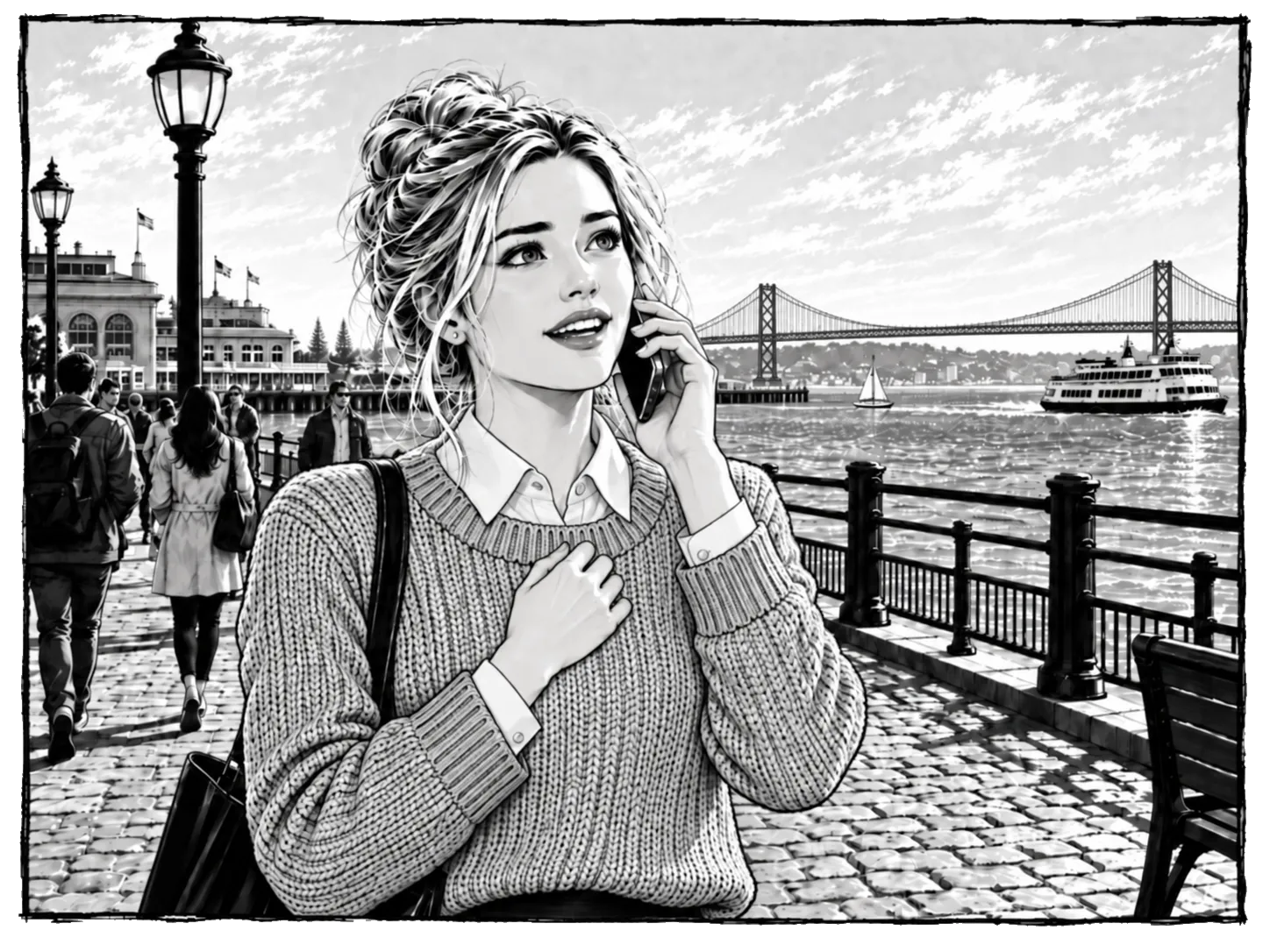
“Hello?” I said, still getting a proper grip on the phone.
“Miss Vale. Have I caught you at a bad time?” Mara asked.
“No. Unless it’s a bad time for you?” I said without a second thought.
She let out a small laugh. “No, Miss Vale. Quite the opposite.”
That was reassuring.
“We’ve finished speaking with the other candidates,” she said. “We’d like to offer you the position.”
I looked out over the water.
A ferry was passing between two smaller boats. I watched it for several seconds before realizing Mara was waiting for me to say something.
“Oh! That’s wonderful. Thank you!”
Somehow I’d forgotten to prepare for the part where they actually said yes.
“You don’t have to decide right now. I’ll send the written offer, including compensation, relocation assistance, benefits and the proposed start date.”
She hesitated a moment.
“You should read it before accepting anything.”
That felt like a given, but I agreed.
I attempted a normal smile at a passing cyclist for no reason. I must have looked half-crazed, since he looked mildly alarmed.
Mara went through the main terms without pretending a verbal summary could replace the paperwork. I wrote them down on the back of the hotel receipt, because naturally the notebook I’d carried through the entire interview was now in my suitcase.
Then I remembered the third question.
“Actually, there’s something I forgot to ask during the interview. Who would I be reporting to?”
“Me for now - I’ll handle any day-to-day questions, performance reviews, time off requests. The founder sets our priorities, but he isn’t in charge of the departments.”
“Understood. I guess you’ll be seeing more of me!” I said teasingly.
Mara didn’t take the invitation.
Instead, she asked when I could give her an answer. We agreed that I’d give her an answer in a week, once I’d had time back home to review the offer and talk to my family.
“One more thing,” Mara said. “We don’t expect you to know the company on your first morning. You will be shadowing me, and your permissions will follow your responsibilities, not the other way around.”
I smiled without saying anything.
“Enjoy the rest of your day, Miss Vale. Reach out when you are ready.”
When the call ended, I stood there with my phone still against my ear.
Someone walking along the waterfront had to step around me.
“Sorry,” I said, and moved.
I wanted to tell Mom immediately. Instead, I waited until Mara’s email arrived, opened the attachment and read the offer from beginning to end on a bench overlooking the bay.
There were things to check: the start date, what moving expenses were covered, how travel worked, and a sentence about occasionally extended hours that I wanted clarified. There was also a salary that made me sit back and read the number a second time.
The job was real now. It had terms and conditions and a deadline.
I called home.
Mom answered with, “Well?”
“Hello to you too, Mamma,” I said, tongue-in-cheek.
“You said they’d call today,” she pushed.
“They did! They just offered me the job!”
She made a noise I couldn’t quite identify—something like a squeaky toy. Then Dad shouted from somewhere behind her, asking what had happened.
“They offered her the job!”
There was a clatter, followed by Dad saying something about the kettle.
“Is everyone all right?”
“We’re fine, sweetie. Are you happy?”
I watched a woman try to persuade a small dog to cross a puddle. The dog had taken a firm position against it.
“I think so… I mean—yes! I really like it here.”
“And the dental?” Dad called to Mom. “Ask about dental! Teeth are expensive in California!”
“You haven’t signed anything yet, have you?” Mom asked.
“No! I’ve got a week to decide.”
“Good. Take the week, then. Think properly.”
“How do you feel about moving so far, sweetie?”
That one took longer.
“I’ll be so far from you and Papa…”
“You’ve moved before,” she said eventually.
“Not this far…”
“No, sweetheart. Not this far.”
We sat with that for a moment. Through the phone I heard the kettle click off.
I tried to work out what time it would be in San Francisco when Mom usually called after dinner.
An ordinary thing to worry about, considering everything else.
But I liked those calls. Sometimes we talked for an hour. Sometimes she just wanted to tell me what Dad had done to the washing machine.
I didn’t particularly want to lose either kind.
“And how long will they give you to find somewhere of your own?” Mom asked.
“A month, but they’ll handle most of it. Packing, shipping my things, somewhere to stay while I look for a place. They’ll even help me close out the lease.”
Dad said something behind her.
“Your father says your books count as furniture.”
“They are probably the heaviest thing I have.”
Mom laughed, but the sound faded.
“So there’s really nothing stopping you.”
“Not much,” I said.
Between them, Mom and Dad helped me make a list of everything I still needed to check before accepting.
I thought of their kitchen, Dad making tea and Mom holding the telephone while the evening went on around them.
Last night I’d wanted to be there.
I still did.
“I’d come back to visit,” I said.
“I know you would.”
“And you could visit me. You’d like the bay.”
“Your father would spend the entire trip looking at that bridge.”
“I have been researching,” he said, much closer to the phone now. “Very serious bridge. Very orange.”
I laughed.
“You sound as though you want to take it,” Mom said.
“I do. I just wish it weren’t so far away.”
She was quiet for a moment.
“I’ll miss you,” she said. “Of course I will. But I don’t want you making your life smaller just to make that easier for me.”
“I’ll miss you too, Mamma.”
Dad had come close enough to hear. “Your mamma and I moved a whole life once,” he said. “We missed people. We were scared. We still went. We would be very silly parents if we told you not to do the same.”
I looked out at the water until I could trust my voice.
“I’d like to see what I can do there.”
Neither of them told me what to do.
Before we hung up, Mom said, “You sounded different when you said you liked it there.”
“Different how?”
“Like you could see yourself there.”
I looked at the written offer again.
“It feels different.”
I stayed out until the light began to fade, then made my way back to the hotel.
I ordered dinner, put the offer beside my notebook on the desk, and tried to read my new book.
I got through the same page twice before giving up.
It was nice, for once, not to have to rush straight from an important day to a departure gate.
The next morning, I went downstairs for breakfast without setting an alarm.
I packed, checked out just before noon, and left my suitcase with reception.
With a few hours before I needed to head to the airport, I took a different route through the city.
I stopped wherever I wanted, bought a postcard I had no immediate plans to send, and found myself looking at apartment windows instead of shop displays.
At one corner I checked the map, realised I knew where I was, and put my phone away again.
I collected my suitcase in the late afternoon. On the ride to the airport, the city passed outside the window in the opposite direction to the one I’d arrived from.
I was going home with a new book, a written offer, and more questions than I’d brought with me.
Two evenings after I got home, I had dinner with Mom and Dad in their kitchen.
Nothing about the room had changed while I’d been away. Dad’s tablet was propped against the fruit bowl, charging from a cable that crossed half the counter.
Mom had made too much food and insisted that this was because leftovers were useful, not because I’d been gone for three days.
My printed offer sat folded on their kitchen counter.
Dad had already read the benefits summary twice and highlighted the dental section in three places. Mom had read the relocation section once and then asked questions it did not answer.
“They really pack everything?” she asked.
“Everything I let them.”
Dad looked over the top of his glasses. “You’ll pack the books yourself?”
“Obviously.”
Mom pointed her fork at both of us. “You two love collecting your books. This is why your backs hurt.”
I laughed and reached for more potatoes.
We went through the practical questions again, but more slowly than we had on the phone. How often I would try to come home. Whether the temporary apartment allowed guests. What I’d do with the furniture that wasn’t worth moving.
Whether I knew anyone in San Francisco well enough to call if I got sick.
That last one sat differently.
“Not yet,” I admitted.
Mom nodded as though she’d expected the answer and didn’t particularly like it.
“Then let’s make sure you have someone before you go,” she said.
Mara was the closest thing I had so far.
Dad got up to put the kettle on.
I looked around the kitchen while they talked about something else. The chipped blue mug Mom always gave me was by the sink. A grocery list was held to the fridge with the same crooked magnet I’d made in school. Dad had left a screwdriver on the windowsill for reasons known only to him.
None of it was important enough to photograph.
That was probably why I wanted to remember it.
When I left later, Mom packed leftovers into a container I hadn’t asked for.
Dad walked me to the door and reminded me that it was an offer, and if I really didn’t want to go, I was allowed to say no.
“I know,” I said.
He nodded. “Good.”
I took the subway home with Mom’s container balanced on my knees and the offer folded inside my bag.
Back in Manhattan, I sent Mara the last of my questions.
She answered most of them herself. The others went to someone who actually knew the answers, which I appreciated. I’d worked with enough people who would rather invent an answer than admit they didn’t have one.
Once the revised start date was confirmed, I was running out of reasons not to decide.
I read through the final offer one more time.
Everything was there.
I opened a reply to Mara and typed my acceptance.
I thought about my apartment, and the boxes I’d have to fill, and how strange it would be to call Mom from a different time zone on an ordinary Tuesday.
Then I thought about Mara and the office and the work I’d spent the interview hoping they’d let me do.
I clicked Send.
There was a small, startling moment when I realised I’d just agreed to move across the country.
Then I remembered I still had to buy more packing tape for the things I wanted to pack myself.
The next morning, I went to work. It felt almost rude in its normality.
The same train was crowded. The same coffee cart was outside the station.
At my desk, someone had left a folder in the wrong tray and a manager was waiting for an answer about a travel request that had been sitting in Finance since Friday.
I knew exactly what to do with all of it, but I didn’t want to touch any of it.
By ten, I’d corrected the travel code, moved two meetings, found the missing approval and reminded someone that “sometime before lunch” was not a time I could put on a calendar.
Nobody applauded. Nobody needed to.
At noon, I went downstairs to the little place where I usually bought lunch. The woman behind the counter started preparing my order before I reached the till.
“Usual?”
“Yes please.”
I almost told her I was leaving.
I’d been buying lunch here for years. She knew my order, asked after me when I was sick, and occasionally slipped an extra biscuit into the bag.
But I didn’t know her name.
I suddenly felt rather bad about that.
“Thanks,” I said, taking my lunch.
“See you tomorrow!”
“See you.”
I wondered how many more times I’d say that before it stopped being true.
I walked back outside.
There were people everywhere: delivery bikes chained to scaffolding, somebody arguing into a headset, a dog refusing to move while its owner negotiated with it.
I had walked that block often enough that I knew where the pavement dipped after rain and which crossing light took too long.
I hadn’t thought of any of it as something I could miss.
Back upstairs, I opened my resignation letter and read it once more before sending it.
The workday continued.
The next few weeks were less cinematic than a big decision ought to have been.
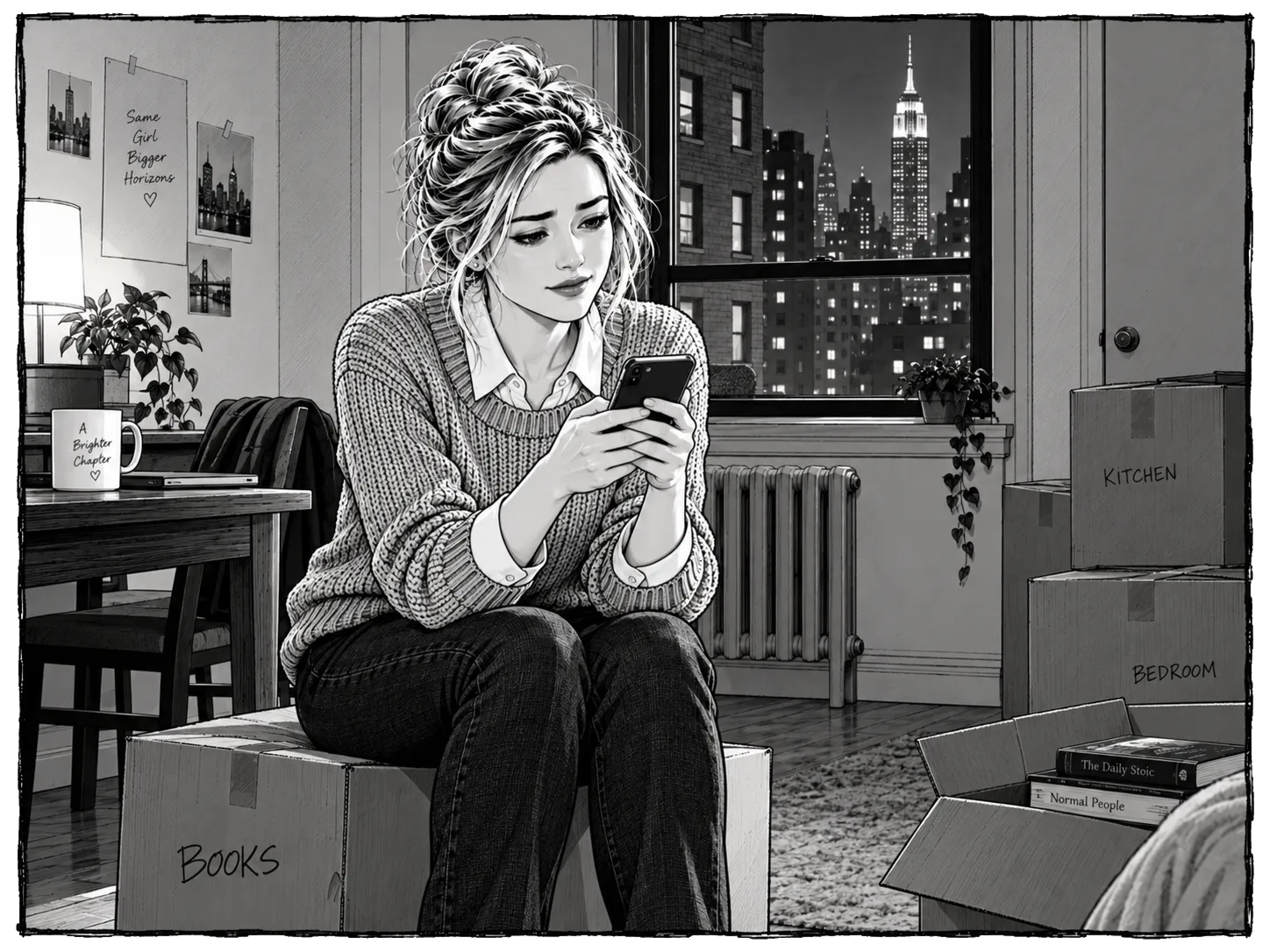
I worked out my notice.
The relocation team arranged the movers, helped with the lease and found me a short-term place in San Francisco while I looked for somewhere permanent.
I had a brief argument with the moving company when its inventory showed my desk as already collected while I was still sitting at it.
Dad sent me a spreadsheet of practical questions. It had four tabs, conditional formatting and a column labelled BRIDGE.
Mom sent me a photograph of my forgotten navy sweater neatly folded on her couch and asked whether she should mail it.
I said she could bring it when they visited.
On my last evening at the apartment, I ate dinner sitting on the box of books I’d insisted on packing myself, because I’d already packed away the chairs.
Without my books on shelves, the apartment looked oddly bare. I hadn’t realised how much they’d made it feel like mine.
It echoed when I laughed at Dad’s final text.
Dental confirmed. Bridge pending.
I kept that one.
A Less Impossible Day
It was 7:18 a.m. when I arrived at Aegis, twelve minutes early.
Mara had scheduled my first day to begin at seven-thirty.
She’d sent me an agenda the evening before: Human Resources, Security, shadowing her, and lunch.
The man at the security desk looked up as I approached. His short curls bounced as he moved.
He tucked his coffee cup beside his monitor and gave me his full attention.
“Good morning. I’m Natalie Vale. It’s my first day.”
“Welcome to Aegis, Natalie. I’m Rafi.” He nodded toward the scanner on the desk. “Tap your badge there. Let’s see what they’ve given you to work with.”
My visitor badge had been replaced by an employee card and they’d reused the photograph from my visitor registration.
I looked like somebody had just asked me to explain a felony.
I held my badge against the scanner.
Nothing.
Oh, brilliant. First day, and they’d already forgotten to give me access.
Then the scanner beeped green.
Apparently it had only been two seconds.
Rafi glanced back at the monitor, and turned his own badge around.
In his picture, his eyes were half shut and his mouth was wide open in what looked like an enormous sneeze.
“They caught me at exactly the wrong moment,” he said. “I asked them to keep it. It’s the best picture I’ve ever had taken for work.”
I was still laughing when Mara approached, a thermos in one hand.
Her dark hair was pinned neatly back above a charcoal jacket. She looked as though she’d been working for hours already.
“Morning, Rafi. Is the overnight access report ready?”
“Yes, ma’am. Sent to your queue at six. Nothing outstanding for your floor. IT fixed the duplicate checkpoint entry too.”
“Thank you.” She turned to me. “You found the right building again, Miss Vale.”
“I checked the address. Twice!” I held up two thumbs.
She glanced at my ID card, now neatly hanging from my neck. “We can retake that photograph, if you’d like.”
“No thanks. Rafi’s made a compelling case for keeping the original.”
Mara rolled her eyes. Rafi caught the look, gave me a quick grin, then returned his attention to the security desk.
I followed her through the gates.
We took the lift to the second floor, where Human Resources came first. I signed forms, collected a laptop and discovered which of the documents that I’d already submitted apparently needed reviewing again.
Imani Calder—the formidable woman who’d registered me at ground-floor reception on interview day—was waiting down the hall in Security.
Her black locs were still tightly restrained, her expression no more forgiving than I remembered, and a diagram was already laid out for us.
“Back again, Miss Vale?”
“With a proper badge this time.”
She smiled and tapped a diagram of the floor plan. Each door had a colored line beside it: some red, more yellow, and a few green near the exits and stairs.
She pointed out where I’d need an escort for the restricted red areas.
“Scan your own card. Every checkpoint. One person through at a time. No exceptions.”
I made a mental note and wondered whether Mara had been doing that this whole time.
On our way back to the lifts, Mara stopped at the administration offices on the same floor to introduce me to Ruth Bell, the office manager.
She had short greying hair, reading glasses halfway down her nose and the sleeves of her cardigan pushed up.
Three people were waiting beside her desk, which was piled with folders.
“Mara!” Ruth looked past the crowd as we approached.
“Ruth, this is Natalie Vale. She’ll be taking over the desk upstairs, shadowing me today.”
She turned to me. “Ruth runs administration down here. You’ll get to know her.”
“Natalie, poor girl. Has Mara let you sit down yet?”
“We’ve been busy!” I smiled and shrugged.
“We’re heading upstairs now,” Mara said.
“Alright. Don’t let her work you through lunch.”
She turned and threaded her way back to her desk, where her entourage had already begun comparing whose question was most urgent.
As we continued toward the lifts, Mara’s phone lit up. She read the notification, tapped out a brief reply, and put it away.
“One of the labs needs an approval before their setup. It can wait until lunch, but I should reply.”
“Is that why you were here so early?” I asked.
“Partly. I run the research labs. I’ve been covering the executive desk until we could get someone in.”
I looked at her. That explained the messages she kept getting.
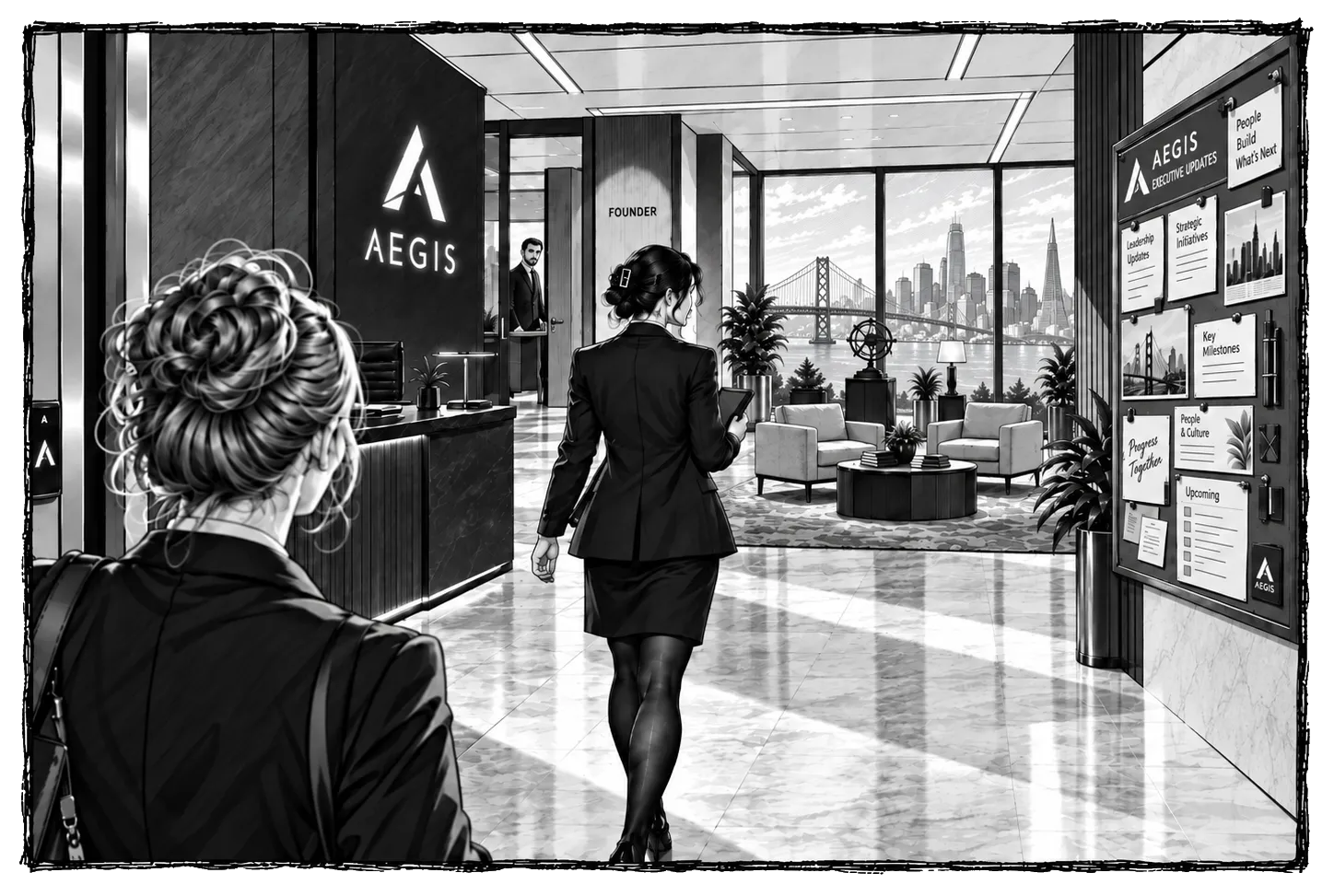
Upstairs was quieter. The executive floor was less imposing than I’d expected.
A few lounge chairs faced the windows, and one of the desks had a printer labelled OUT OF ORDER in three different handwritings.
An executive memo board held schedules, notices and department updates. One memo stood out: an Immersive Systems safety review, like the one I’d read about.
The founder’s door was open.
He looked up from his tablet as we stepped out of the lift, then came to his doorway.
“Miss Vale, good to see you again,” he called over the office.
I waved, not wanting to yell. Mara noticed and shooed him back into his office.
He gave her an acknowledging nod. “I hope the first day goes well,” he called over the office again.
“Thank you, sir,” I said, slightly louder than I was comfortable with.
He stepped back into his office, already looking at the next item on his tablet.
Mara showed me to my desk.
It was a beautiful dark marble slate with wooden accents. A raised portion kept my desk hidden from above, and a small plant sat on the ledge.
Someone had set out a notebook, a packet of coloured pens, and a small card.
It was a welcome note from the office team, signed in several different colours.
I picked up the card. Someone had added a shiny sticker of a cat giving a thumbs up. An excellent choice, frankly.
I recognised Mara’s name, the founder’s and Ruth’s. There were four more I hadn’t met yet.
I’d spent the last few weeks packing up my life and saying goodbye to people. It hadn’t occurred to me that there might already be people here looking forward to meeting me.
The desk was to the left of the lounge, near enough to see people coming off the lifts.
Beyond the windows the city was already getting on with its morning.
I rested a hand on the back of the chair.
I pulled the chair out and sat down. It needed adjusting. Naturally.
Mara touched the card. “Most of the office team is tied up today. I’ll introduce you when they’re free.”
I slipped the card into my new notebook before Mara could notice how long I’d been staring at it.
Mara pulled up a chair beside me and we opened my fresh laptop.
After a bit of set up, we had the founder’s office intake queue on my screen.
“Executive requests,” Mara said, pointing to the queue. “Routine intake and scheduling will be yours. Anything needing a department’s decision still goes to that department.”
Her phone vibrated again. She glanced at it, typed After eleven, and turned the screen facedown.
“Let’s review this one.”
She opened a request from a department head who wanted the founder to overrule Facilities about a meeting room. The alternative room was fine; he simply wanted the original one.
Mara showed me Facilities’ response. The department head had been offered another room of the same size, with the equipment he’d asked for.
“They’ve already offered him another room,” I said.
“They have.”
“And he’s asking again because…?”
“He prefers the first one.”
I looked at her.
“That’s it?”
“That’s it.”
I drafted a reply declining to reopen the room assignment.
I drafted the response in the intake system.
“Am I replying as myself?”
“Here, you’re responding on behalf of the Founder’s Office,” Mara said. “Use your own company email for ordinary correspondence.”
I read my reply aloud before sending it. It was more polite than the one I’d composed in my head.
We recorded the outcome and moved to the next item.
There were considerably more requests than I’d expected for an office that wasn’t supposed to decide everything.
“People can request a decision,” Mara said. “That doesn’t mean they get to choose who makes it.”
She gave me a routine scheduling change to try next, checking my entries as I went.
By lunchtime, I had learned where the stationery lived, whom to call when a meeting room vanished from the booking system, and that the founder had put two appointments in the same slot on tomorrow’s calendar before we’d even arrived.
Mara showed me how to leave a request for her without expecting her to hover over my shoulder all day. Then she checked the time.
“There’s a lab setup I need to attend to. Eat something; I’ll find you after lunch.”
I watched her go toward the lifts, thermos in hand. It was the first time all morning that I’d been left to find my way around the floor alone.
I took the lift down to the shared third-floor lunch area, made a sandwich from the supplies in the kitchen fridge, and spent an embarrassingly long time trying to work out which cupboard held the plates.
I took my lunch to a seat overlooking the street. Nobody seemed particularly interested in whether I was managing, which I decided to take as a good sign.
Ruth came up from the administration floor with a mug of tea and noticed the paperback sticking out of my bag.
“Any good?”
“I haven’t read much yet, but I’ll let you know.”
“Thanks, dear. I’ve been looking for something good for the weekend.”
That sounded like a reasonable deadline. I used to love talking about books back home.
Someone called to Ruth from the doorway, and she took her tea back down to the offices.
Mara returned as I finished my sandwich. She’d been down in the basement research labs, where somebody had apparently booked a room without allowing time to prepare it.
“Sorted,” she said.
Back upstairs at my desk, she pulled up a chair. Almost on cue, the intake queue chimed. This time she let me open the request.
“You take this one,” she said. “I’ll be right here.”
My first actual problem involved a visiting director who wanted the founder to override an equipment purchase that Operations had already declined.
He’d requested a meeting, been refused, and submitted a second request under a different project name, this time addressed directly to the founder.
The paperwork looked complete, but Operations had already denied the purchase on safety grounds. The equipment was intended for a scheduled Immersive Systems test—the same programme I’d noticed on the executive memo board that morning.
The new request stressed its urgency without mentioning the denial.
I didn’t understand what the equipment actually did. I did understand that changing a project name didn’t change a purchase reference.
I opened the earlier record beside it. The project names were different, but the equipment reference number was the same.
“He’s on the phone,” Mara said. “Would you like to take it?”
I glanced at her, clearly nervous. She didn’t rescue me. She did slide the earlier decision across the desk.
I skimmed the record and reached for the call controls.
“Hello? Founder’s Office, Natalie speaking.”
Nothing.
I glanced at Mara. She was writing on her tablet as though this were perfectly normal.
I panicked and pressed the icon that looked most like a receiver.
“You’ve put him on hold,” Mara said.
“That wasn’t quite what I meant to do.”
She pointed to the right button without making a fuss. I took a breath, pressed it and tried again.
“Good afternoon. Natalie Vale, Founder’s Office. Thank you for holding.”
He began by telling me that the equipment was essential, that the founder understood its importance, and that he’d been trying to reach somebody capable of making a decision all morning.
“I can see Operations reviewed the request and denied it because of the noted safety concerns,” I said when he paused. “Is there new information they haven’t considered?”
“I need the founder to see it.”
“I understand that’s what you’ve asked for. I’m trying to establish whether anything has changed since the decision.”
He sighed in a way that made me feel about twelve years old. I waited.
Eventually he said he’d speak to his team and come back to us. Then, almost as an afterthought, he added, “The equipment will arrive too late for the scheduled test unless this gets approved.”
That did sound important.
“Has the schedule changed?”
There was a pause.
Before I could ask for the revised dates, he ended the call.
I checked the earlier record. It still showed the original delivery and test schedule, with nothing supporting what he’d just told me.
“I’m going to record the escalation,” I said to Mara. “Operations should know he’s claiming the current timing puts the test at risk, but they’ll need the revised information before they can reassess anything.”
From the office to our left, I could hear the founder speaking firmly to someone on another call. For a second I wondered whether I ought to interrupt him.
Mara didn’t look toward his door.
“I’ll send Operations the note. They can decide whether the new information changes the purchase decision or the test schedule.”
“And if they still say no?” Mara asked.
“Then the decision stands.”
I put the phone down and looked at it for a moment.
“Well,” I said. “I think he hates me.”
“He doesn’t know you,” Mara said.
“That didn’t seem to discourage him.”
She returned to her tablet. I decided that was as close to sympathy as I was going to get.
I logged the claimed timing risk with the earlier decision, sent it to Operations, and left the founder’s meeting request pending.
Then I asked Mara to check my work.
“You did well,” she said. “He’ll probably try again.”
“Do we keep a tally?”
“Not an official one.”
I looked at the queue. There were forty-three other requests waiting.
A message appeared on Mara’s tablet, and she read it with the expression of someone whose other working day had continued without her.
“Another lab problem?” I asked.
“Not a problem yet.” She put the tablet aside and nodded toward the queue. “Show me how you’d handle the next one.”
We got back to work. I was beginning to suspect she meant to make herself unnecessary here as quickly as possible.
I stayed a little later than planned, mostly because I’d underestimated how long it would take to write notes that another person could actually use.
The office had changed over the afternoon: a few empty mugs had appeared in the lounge, the broken printer had acquired a fourth warning, and people I’d only seen in passing had begun to say goodnight to me by name.
Before leaving, I checked tomorrow’s calendar with Mara. One appointment was still marked tentative, and a lunch break had somehow acquired a meeting request on top of it.
“Does he know that’s there?” I asked.
She looked at the screen.
“He put it there himself.”
“Of course he did.”
We sent him a request to clarify which appointment he wanted to keep. Mara closed her laptop and picked up her bag while I gathered my things.
“Don’t stay here trying to finish tomorrow’s work,” she said. “It’ll still be here in the morning.”
“That’s comforting.”
“You’ll get used to it.”
I walked past my new desk and switched off the lamp I’d left on.
At reception, Rafi was handing over to the next shift. He raised his badge in greeting, a gesture that looked a little like a salute.
“Still keeping it?” he asked.
“For today. You’ve raised the standard.”
He laughed, and I headed outside.
The evening traffic was moving toward the water. My phone buzzed as I reached the pavement.
First day survived? Mom had written.
Survived! They even gave me a desk of my own, I typed.
A moment later, she reacted with a thumbs up.
I found a little place on the way back to my temporary apartment and ordered dinner at a table by the window.
The paperback was still in my bag, so I took it out while I waited.
I got through another three pages before the food arrived. Progress. As far as I could tell, the character was leaving home on an epic quest with a wizard.
Outside, people were heading home with shopping bags and bicycles, arguing over where to eat and stopping to greet dogs.
I remembered there were still four names on my welcome card that I hadn’t yet put faces to.
It had been a strange first day. I’d put a man on hold by accident, learned that the printer upstairs had apparently been broken for years, and met someone who thought an awful badge photograph was something worth keeping.
I was looking forward to tomorrow.
I took a photograph of my dinner and sent it to Mom.
Evidence, I wrote.
Then I put the phone away and opened the book again.